
Direct answer
What should you do?
Vision control reduces expensive guesses. Use watchtowers to reveal routes and movement, scout the exact question your alliance needs answered, and report location, direction, timing, and confidence rather than sending an unstructured warning.
Key takeaways
- A watchtower is valuable because of the decisions its vision enables.
- Scout routes and response time, not only visible targets.
- Share concise reports that another player can act on immediately.
1. Turn hidden space into a question
Do not scout the haze randomly. Ask a specific question: Is the route to a resource safe? Can enemies reinforce a fortress? Where did a moving MCV leave vision? A focused question determines what information is enough.
Watchtower control expands shared knowledge. Compare the revealed area with the objective and the alliance's ability to act on it.
- Identify the decision that depends on vision.
- Reveal the route as well as the destination.
- Check how quickly information could become outdated.
2. Read movement, not only position
A visible commander is a snapshot. Direction, travel time, nearby objectives, and likely support reveal more than the icon alone. Watch whether movement continues, stops, or draws additional troops.
Avoid overreacting to one sighting. Confirm whether the movement threatens the current objective or is simply passing through.
- Record location and direction.
- Estimate arrival rather than saying only 'enemy nearby.'
- Distinguish confirmed movement from inference.
3. Report information for action
A useful alliance report is short: what was seen, where, when, which direction, and what decision may be required. Screenshots help when they include the relevant map context.
Close the loop after the alliance acts. Confirm whether the route remained safe, the enemy changed direction, or the objective no longer matters.
- Use consistent map references.
- State confidence when the haze limits confirmation.
- Update or cancel an old warning so it is not treated as current.
Try this decision
A practical exercise
Part of an approach is visible, but you cannot see the area beyond it. Treat that missing information as a question to resolve.
- Mark the known objective, visible route and unseen area in your own notes.
- Use available scouting or vision systems after checking their current rules.
- Update the route or timing when the new information changes the risk.
Check the result: Name the decision that changed because of vision. A clearer map is useful when it improves movement, support or target selection.
Illustrative scenario added September 9, 2026. This is a planning exercise, not a recorded test result or a new live-game rule. The version scope above still applies.
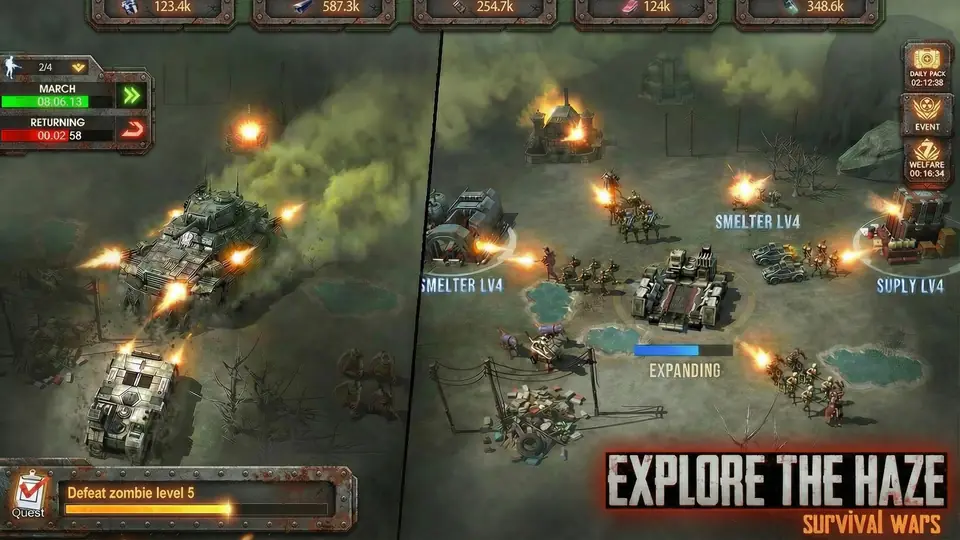
- Across the top: resource counters show the state of the pictured account.
- Upper left: ‘MARCH’ and ‘RETURNING’ indicators show that timing belongs in the plan.
- Right-hand scene: the visible structures and remaining haze illustrate the difference between known and unseen space.
Decision table
| Question | Information needed | Action |
|---|---|---|
| Can we move the MCV? | Destination, route, nearby movement | Move, delay, or choose another route |
| Can we hold a fortress? | Enemy direction and reinforcement time | Reinforce, rotate, or withdraw |
| Is a resource safe? | Approach routes and nearby commanders | Gather with margin or leave it |
| Where did the threat go? | Last location, direction, elapsed time | Refresh vision before committing |
Frequently asked questions
Why are watchtowers important?
They expand vision, reveal movement, and reduce uncertainty around routes and objectives.
What should an alliance scout report include?
Include what, where, when, direction, likely arrival, and whether the information is confirmed or inferred.
Does more vision always mean more control?
Only when the alliance can interpret and act on the information. Vision without a decision process can still be wasted.
Official sources and scope
This guide is based on current official product information and product-team review. Exact values, event rules, and unlock requirements can change; verify time-sensitive details in the live game.
Continue in game
Play Over Hazed
Use the guide as a decision framework, then confirm current values and rules in the live game.